In the comments on my last post, Alonso asks a great question. He wants to know more about entertainment. I don’t have all the answers but here are some thoughts…
It’s that old phrase “give ’em what they want in an unexpected way.” Easy to say, hard to do because if you keep throwing away the obvious choices, you run the risk of just doing weird or quirky for the sake of it and maybe taking the idea way off course.
I wrote down this hypothetical for myself a couple years ago:
“If the director sees your shot and decides they don’t like your idea, what would you do instead?”
I like exploring this possibility when conceiving a shot because if this happens, you have no choice, you have to come up with something that not only satisfies the director but also your interest in animating the shot. You have to believe in the work you’re doing.
“Emotionally authentic” is what I mean by the first section of “believable performance,” so “entertainment” is something else. “Emotionally authentic” and “believable performance” is the standard. Every shot has to have that but when you push beyond believable and do it in an unexpected way, the audience gets jolted out of their boredom. THAT’S entertaining for THEM. The audience is the one who matters.
We see people being normal all day. Even worse, we see people acting normal in movies (and especially animated ones) all too much. It’s the brilliant animators/actors who turn ideas on their ear and make the audience see something that rings true, but new.
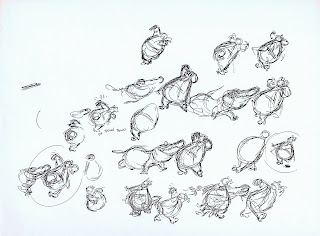
Of course, entertainment takes many forms – acting beats, timing choices, poses, etc. I always think of Milt Kahl as someone who never went for the first idea, at least for a great pose. Look at this image from Andreas Deja’s great blog as an example:
Or this Milt image from Mark Kennedy’s blog:
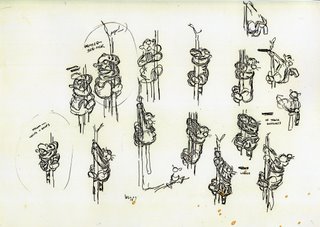
There are tons of examples of Milt always searching for the most entertaining and clear pose for an action. And it’s not even always crucial shots but he continually searched for a creative way to solve problems visually. That’s just one of the reasons why people still study his drawings and scenes. As great as he was, he didn’t go with his first thought.
So how to learn to be entertaining? That’s the trick, isn’t it?
It’s part taste – what do you like and what do you respond to?
It’s part personality – do you have your own take on things that other people wouldn’t have?
It’s part observation – watch people, keep a sketchbook and STEAL their behaviors for your scenes. This is why EVERY animator should have a sketchbook to record life.
It’s part discipline – don’t allow yourself to do the easy, obvious choice. Any good animator can do that so make yourself irreplaceable and bring what they aren’t thinking of.
Here’s a great compilation of Cary Grant moments. (It won’t play here, but click it then click through to YouTube.) He endures as one of cinema’s greats because he repeatedly created memorable performances by doing things with his unique spin. He was an ENTERTAINER! You’ll probably want to turn off the music, but maybe you’ll like it. Notice the parts you respond to. When do you smile? (That’s you being entertained, by the way.) I bet it’s when he does things that you don’t expect.


Leave a Reply