Yesterday I found an old notebook with a letter to myself that I never intended to share with anyone. It was written 13 years ago in 2000. It’s about me finding my process of hand-drawn animation – a collection of things I was finding to be true along my way and some pumped up advice on how to be courageous. I was going to post it here, but felt that it might better serve Willie Downs’ Animator Letters Project and he was gracious enough to post it there. I got a kick out of reading it all these years later and I hope someone else does too. If you have any comments, please leave them on the post on Willie’s site. I’ll be disabling the comments on this post.
Category: Notebook
My thoughts on animation
-
Entertainment: when it rings true, but new
In the comments on my last post, Alonso asks a great question. He wants to know more about entertainment. I don’t have all the answers but here are some thoughts…
It’s that old phrase “give ’em what they want in an unexpected way.” Easy to say, hard to do because if you keep throwing away the obvious choices, you run the risk of just doing weird or quirky for the sake of it and maybe taking the idea way off course.
I wrote down this hypothetical for myself a couple years ago:
“If the director sees your shot and decides they don’t like your idea, what would you do instead?”
I like exploring this possibility when conceiving a shot because if this happens, you have no choice, you have to come up with something that not only satisfies the director but also your interest in animating the shot. You have to believe in the work you’re doing.
“Emotionally authentic” is what I mean by the first section of “believable performance,” so “entertainment” is something else. “Emotionally authentic” and “believable performance” is the standard. Every shot has to have that but when you push beyond believable and do it in an unexpected way, the audience gets jolted out of their boredom. THAT’S entertaining for THEM. The audience is the one who matters.
We see people being normal all day. Even worse, we see people acting normal in movies (and especially animated ones) all too much. It’s the brilliant animators/actors who turn ideas on their ear and make the audience see something that rings true, but new.
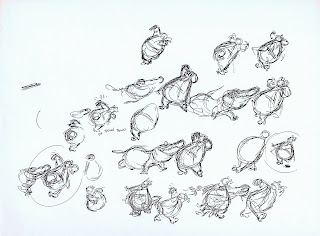
Of course, entertainment takes many forms – acting beats, timing choices, poses, etc. I always think of Milt Kahl as someone who never went for the first idea, at least for a great pose. Look at this image from Andreas Deja’s great blog as an example:
Or this Milt image from Mark Kennedy’s blog:
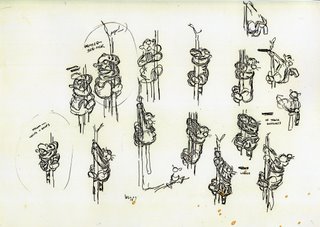
There are tons of examples of Milt always searching for the most entertaining and clear pose for an action. And it’s not even always crucial shots but he continually searched for a creative way to solve problems visually. That’s just one of the reasons why people still study his drawings and scenes. As great as he was, he didn’t go with his first thought.
So how to learn to be entertaining? That’s the trick, isn’t it?
It’s part taste – what do you like and what do you respond to?
It’s part personality – do you have your own take on things that other people wouldn’t have?
It’s part observation – watch people, keep a sketchbook and STEAL their behaviors for your scenes. This is why EVERY animator should have a sketchbook to record life.
It’s part discipline – don’t allow yourself to do the easy, obvious choice. Any good animator can do that so make yourself irreplaceable and bring what they aren’t thinking of.Here’s a great compilation of Cary Grant moments. (It won’t play here, but click it then click through to YouTube.) He endures as one of cinema’s greats because he repeatedly created memorable performances by doing things with his unique spin. He was an ENTERTAINER! You’ll probably want to turn off the music, but maybe you’ll like it. Notice the parts you respond to. When do you smile? (That’s you being entertained, by the way.) I bet it’s when he does things that you don’t expect.
-
Some basic animation reel advice
First of all, hi everybody. I’m inching my way back to the site. So much clean up, dusting off and re-learning how to do things around here but that’s for me to worry about, not you. Here’s a baby step in the right direction.
I received an email this week asking for some advice on what would help someone get into the animation trainee program at Disney. My answer applies to any level of animator. Of course, I think this advice would help many people, so here is my brief, but fairly complete, answer.*
Four things that make a reel work, in order of importance:
Believable performance. Not necessarily “realistic” but believable for the style of animation and situation. This is the part that is hardest to teach. Do your characters show that they are thinking, making decisions, judgments, choices on their own. Do the expression, body posture and dialog shapes accurately reflect what is being said (or what isn’t being said)? Over acting, bad acting, unbelievable acting, and acting that does not fit the situation – those are the the biggest turn offs.
Convincing physics. Do you know how to move characters? Do they have weight? Will I believe they exist in a reality that has gravity? Do they feel like they are built of flesh and bone and not just filled with empty space? Are movements motivated by internal forces – both mental and physical?
Entertainment. Do you have original ideas and ways of solving problems that aren’t typical? Show us how you think that’s different from the crowd. Do you pass over the obvious and make choices that are surprising AND appropriate for the situation?
Polish. This is the bonus round. All of the above are most important but if you can do them along with great polish – spacing, arcs, timing, slow-ins/outs, no pops or wonkiness, obvious care in the details – then your work will stand above the rest.
You may look at your body of work and think that you’re missing some of these things. Well, what is stopping you? You have the tools to animate. You can carve out some time. Do it and animate something new that gives us all of these things and your chances of getting the position you want will greatly improve!
*Of course, this is my own opinion and I am not attempting to represent Walt Disney Animation Studios. With that said, I have worked there forever and I’ve seen thousands of reels and hired scores of people.
UPDATE:
Here’s a follow up post. -
Q&A: Using generic rigs
Q. I was wondering if you had any idea about how recruiters react when seeing generic rigs in the demo reels they receive. I heard that they lose interest as soon as they see animation created using certain “free online rigs”.
(more…) -
New blog section: Q&A!
The crazy thing about me doing an audio show is that I sometimes find it so darn tough to put my thoughts in to words and then have those words come out of my mouth. Go figure! While I will always strive to improve my “on the air” skills, I find that I receive quite a few questions from listeners that I would like to answer and share with everyone. Most of the time I try to reply to emails, but that only gets the info to one person. To do that in the podcasts would take more time than I’d like to admit. So today a new section is born!
Simply put, it’s Q&A.
When I get a question in an email or in the comments of one of the posts that is worthy of singling out, I’ll break it out and drop it in it’s own Q&A post. Eventually, there may be quite a bit of information here that many people would like to know so it seems logical to keep it under the Animation Notebook section of the site.
Look for the first Q&A later today.
-
Ones and Twos
I’ve already posted this in a comment and explained it in Show 3, but to keep things organized and findable, here’s where you can find my explanation of “What are ones and twos?”
ONES and TWOS
Here’s my explanation of ‘ones and twos.’ I also talk about it at the end of Show 3.
You can find this in the comments of one of the posts but I’ll put it here so it’s easy to find.Film has 24 frames per second. Each frame has a different drawing, or image, and when they are viewed in succession through a projector, the images connect and create the illusion of motion thanks to what is called persistence of vision. That’s all simple enough.
If each drawing is numbered according to which frame it falls on, it would look like this:
1 2 3 4 5 6 7 8 9 10 11 . . .
In traditional (hand-drawn) animation, every frame can hold a different image but animators realized long ago that they could get by with only doing a drawing every other frame, saving extra work. The drawings would be “held” on two consecutive frames so that in one second, instead of doing 24 drawings (one every frame) they could do 12 drawings (one every other frame).
The numbered drawings would look like this:
1 – 3 – 5 – 7 – 9 – 11 . . .
and drawing 1 is repeated in frame 2, drawing 3 repeats in frame 4, etc.
Persistence of vision comes into play again and the action still looks fluid. A drawing held for two frames is called “on twos.” Logically, when each consecutive frame has a new drawing, it is called “on ones.”
It’s up to the animator to decide when to animate on ones and twos. Generally, the determining factor is how it will look in the end. If it is animated on twos (12 drawings per second) and there seem to be gaps in the action, the animator can go in and add new drawings to make it look more fluid.
If this series of drawing doesn’t look smooth enough (between 3 and 7):
1 – 3 – 5 – 7 – 9 – 11 . . .
we can add a drawing where it is needed like this:
1 – 3 4 5 6 7 – 9 – 11 . . .
Something that didn’t make sense to me when I first heard it is that faster action should be animated on ones. I thought, “Well won’t more drawings slow it down?” Not really, since we’re not adding time. The frames stay the same, we’re just putting more images in to connect the action. You may think of it as a strobe light. If it flashes slowly (on twos) and you wave your arms around, it may be hard to follow the motion. If we speed up the flashing (on ones) the action connects visually because there are more images shown in the same amount of time.
This is REALLY hard to get across in words alone, and I know I can tend to be verbose, but I hope this helps. If you pause traditional animation and advance frame by frame, you will be able to see which sections are on ones and which are on twos. Of course if you’re looking at some Saturday morning cartoons, they get away with animating on 12s, 24s, or worse.
We commented about The Thief and the Cobbler in Show 2 because Richard Williams prefers to animate nearly everything on ones.
CG is nearly always done on ones. In Fantasia 2000 some of the Tin Soldier sequence was animated on twos, but that is a rare instance.
-
Principles of Animation – Planning
From time to time between ‘casts (believe me, it’s a lot faster to write than to cut a show) I’ve decided to start posting some animation notes I’ve collected/written for myself over the years. I won’t commit to how often or in-depth this will be, but it’s better than a poke in the eye with a sharp stick, right?
I’ll start with some notes I put together for a talk I gave about the fundamentals of animation. They may not be the same as someone else’s list, but they are the things I wouldn’t animate without. Rather than just dump them all at once, I’d rather post one at a time and hopefully you’ll have a chance to read through them and add thoughts or ask questions.